Hydronic Heating & Cooling Specialists
Home/Hydronic Underfloor Heating Brisbane
Brisbane, QLD · installed by AHHAC

Hydronic underfloor heating Brisbane — one floor that heats and cools.

In-slab and in-screed hydronic floors for South-East Queensland, driven by a reversible heat pump that warms the slab on cool winter mornings and chills it through the humid summer, with dew-point control so floors never sweat. Designed and installed from our Banyo showroom.

The short answer

Updated

Hydronic underfloor heating in Brisbane works best as a two-way system: a reversible heat pump warms the floor at 35–45 °C on cool winter mornings, then sends chilled water through the same loops for silent summer cooling, with dew-point sensors and fan coils keeping floors dry in the humidity. It suits new slabs and lift-and-build-under renovations best. AHHAC designs every system from a room-by-room heat-loss calculation and installs from our Banyo showroom.

Underfloor flow temp
35–45 °C
Heat-pump COP
3.5–5.5
Whole-home installed
$20k–$60k+
Showroom
Banyo, QLD

Reviewed by the AHHAC Technical Team — licensed plumbers & hydronic engineers, NSW Lic 262528C.How we write & review

Authorised supplier & installer
Maxa authorised supplierViessmann authorised installerImmergasSimeThermaSkirt™
Plumbing Lic 262528CABN 85 164 746 4906 showrooms · NSW · ACT · VIC · QLDEst. 1998

Most people researching hydronic underfloor heating in Brisbane are really asking a bigger question: is a warm floor worth it in a city where winter lasts a couple of months? Our honest answer is that heating alone rarely justifies the cost here. What does justify it is running the same pipework both ways. A reversible heat pump sends warm water through the floor loops on cool June and July mornings, then switches to chilled water for the long, humid summer, turning the slab into a large, silent cooling surface. That is how we design underfloor heating and cooling in Brisbane, and it is the only way we recommend it.

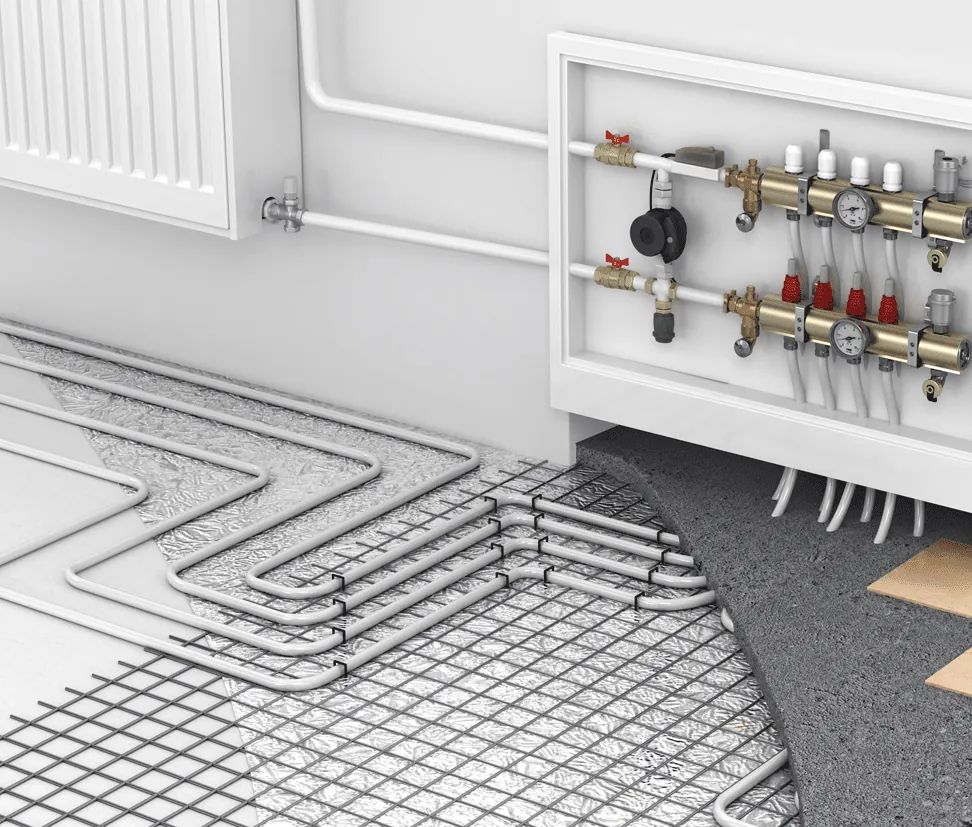
The system itself is simple. Pipework is laid in loops across each room, either cast into a new concrete slab or set into a thin screed over an existing floor, and run back to a manifold with a zone for each area of the house. In winter the heat pump supplies water at 35–45 °C, the low flow temperature where a heat pump works most efficiently, at a COP of 3.5–5.5. In summer it reverses, and dew-point sensors watch the indoor humidity so the floor is never cooled to the point where moisture could form on it. There are no grilles, no fan noise and no dust blown around the house, which matters to the many households we meet who live with asthma or allergies.

AHHAC designs and installs hydronic floor heating across QLD from our showroom at Lot 4, 457 Tufnell Road, Banyo, covering Greater Brisbane, the Gold Coast, the Sunshine Coast, Ipswich, Logan and the Redlands. Every system starts with a room-by-room heat-loss calculation, and for a floor that also cools we look just as hard at summer heat gain through glass and roof. The fixed-fee design and quote come back within 24 hours of the site visit. This page sits within our wider hydronic heating Brisbane service, and our main hydronic underfloor heating page explains the emitter itself in more depth.

Why a Brisbane floor has to earn its keep in summer

Underfloor cooling works by radiant exchange. A floor a few degrees cooler than the room quietly absorbs heat from people, furniture and the air above it, so the house feels comfortable at a higher thermostat setting than a split system needs, with no cold draught across the bed. It is a very different feeling from blown air, and for many people it is the main reason to choose hydronic cooling at all.

It does have limits, and we would rather explain them now than after the slab is poured. A floor can only be cooled so far before it feels cold underfoot or approaches the dew point, so it handles the steady part of the cooling load well but cannot pull a hot room down quickly, and it removes no moisture from the air. On a muggy February afternoon, humidity is a large part of what makes a Brisbane home uncomfortable. That is why most of our designs pair the floor with one or more hydronic fan coils on the same chilled-water circuit to dry the air, and why rooms with big west-facing glass often get a fan coil of their own. Our overview of hydronic cooling systems explains how floors and fan coils share the work.

Dew-point control: the detail that makes or breaks it

The make-or-break engineering for underfloor heating and cooling in Brisbane is condensation. If any surface is chilled below the dew point of the surrounding air, moisture forms on it. So every cooling zone we install carries a sensor that reads temperature and humidity, and the controller continuously works out the dew point and lifts the chilled-water temperature as the air turns humid. On the stickiest days the floor simply cools a little less while the fan coils take the moisture out, and the surface stays dry.

The same thinking runs through the rest of the install. Chilled-water pipes running through a hot roof space or a humid subfloor are insulated with closed-cell lagging and sealed joints, because an uninsulated cold pipe in Queensland air will drip. The system water is dosed with inhibitor, and we talk through how the house will actually be used, because a cooled floor and a sliding door left open to a humid deck all afternoon do not mix. None of this is visible once the job is finished, but it is where a cheap install and a properly engineered one part ways. The most common pitfalls are listed in our guide to underfloor heating mistakes to avoid.

In-slab underfloor for new builds on the growth fringe

New homes are where hydronic underfloor makes the most sense in South-East Queensland, because the pipework goes in before the concrete and costs a fraction of what a retrofit would. That makes the growth corridors on the fringe its natural home: Ripley and Springfield to the west, Yarrabilba and the southern Logan estates, Caboolture West and the Moreton Bay north, Coomera and Pimpama between Brisbane and the Gold Coast, and Caloundra South and Palmview on the Sunshine Coast.

Most project homes in these areas sit on waffle-pod slabs designed for reactive clay. The pipework is tied to the top reinforcing mesh, above the pods, so it sits in the concrete topping close to the finished floor, which helps the floor respond. We work with your builder and slab engineer on the loop layout, keep the loops under pressure while the concrete is poured so any damage shows immediately, and specify insulation at the slab edge where the design allows, so the floor works with the heat pump rather than leaking warmth to the garden in winter. Timing matters: we need to be involved before the slab is booked, not after.

In-screed underfloor for renovations and extensions

For an existing home, an in-screed system is laid over the current slab: insulation board, pipework clipped at close centres, then a thin self-levelling screed ready for tile or timber. It suits a renovated open-plan living area, a new extension or a full ground-floor refit, and because there is less mass to warm or cool it responds faster than an in-slab floor. The trade-off is floor height. A screed raises the finished level, so door thresholds, the step out to a deck and kitchen joinery heights all need planning from the start. Where that cannot work, radiators or fan coils are the better answer, and we will say so.

Queenslanders and raised timber floors

The classic raised timber Queenslander is the hardest Brisbane house for underfloor, and we are upfront about that. With an open, ventilated subfloor beneath the boards, much of the heat is lost downward in winter, and chilled pipes in humid subfloor air are a condensation risk in summer. In an unrenovated Queenslander we usually recommend fan coils for cooling and slim hydronic radiators or heated towel rails where winter warmth matters, with the pipework run neatly through the subfloor.

The exception is one of Brisbane's favourite renovations: lifting the house and building in underneath. That new ground level sits on a fresh slab, which is the ideal place for in-slab underfloor heating and cooling, while the original timber rooms upstairs keep their character with radiators and fan coils run from the same heat pump. If you are planning a lift-and-build-under, bring us in at drawing stage.

Floor finishes that suit heating and cooling

Brisbane homes already favour the finishes that work best with a hydronic floor. Porcelain tile, stone and polished concrete pass heat in both directions easily, which is exactly what a two-way system needs. Engineered timber works well when it is rated for underfloor use and the slab is brought up to temperature gradually before it is laid. Thick carpet on heavy underlay behaves like a blanket and blunts both modes, so carpeted bedrooms are usually better served by a fan coil or a radiator.

The heat source: a reversible heat pump

Every two-way floor we design is driven by a reversible, all-electric air-to-water heat pump, usually the Maxa i-290 with natural R290 refrigerant (a heating COP of 4.94 on the 16 kW model, in a 6–27 kW range) or the R32 Maxa i-32V5. Brisbane's heaviest load is summer cooling, and it peaks when rooftop solar is producing most strongly, so a solar-equipped home can carry much of its cooling on its own generation. The i-290 can also heat water to 78 °C, so in the right configuration one outdoor unit can look after domestic hot water as well. Our heat pump hydronic heating Brisbane page covers unit sizing and siting in detail.

What it costs, and what moves the price

Whole-home hydronic systems we install range from $20,000 to $60,000+. As a reference point, our published figure for a 200 m² Sydney home with in-slab underfloor and a heat pump is $30,000–$55,000, and an in-screed retrofit is typically $22,000–$45,000. Brisbane projects are quoted on the same room-by-room basis, and a heat-and-cool floor adds dew-point sensors, insulated chilled-water pipework and usually a fan-coil stage, so the design rather than the floor area decides where you land. Small-scale technology certificates apply only to registered heat pump and solar water heaters, not to air-to-water heat pumps used for space heating, so do not budget on a certificate discount for the heating system; our heat pump rebates guide has the detail. For the full payback picture, read is hydronic heating worth it in Brisbane.

Who it does not suit

We regularly talk Brisbane owners out of underfloor. If you only want warmth for a few cold weeks a year, a couple of reverse-cycle split systems will cost far less. If you plan to sell within a year or two, you will not see the comfort or running-cost return. And if the house is a raised timber home you are not renovating, or mostly carpeted, other emitters will serve you better. Our comparison of hydronic heating vs reverse-cycle air-conditioning sets out the trade-offs plainly.

Gold Coast, Sunshine Coast and the hinterland

From Banyo we also design and install hydronic heating on the Gold Coast, whether it is a canal-front home in Broadbeach Waters or a new build at Hope Island, and right across the Sunshine Coast. Near the water, salt air is hard on any outdoor coil, so we site the heat pump out of the direct sea breeze where we can, choose coastal protection options and include coil washing in the annual service. Up in the hinterland, at Tamborine Mountain, Maleny and Montville, winter nights are noticeably cooler than on the coast, and the heating side of the floor earns more of its keep.

Why Brisbane homes choose this system

  • Heats in winter and cools in summer through the same floor loops, from one reversible heat pump
  • Dew-point sensors plus a fan-coil drying stage keep floors dry in Brisbane humidity
  • In-slab for new builds on waffle-pod slabs; in-screed for renovations and extensions
  • Low 35–45 °C flow temperature keeps the heat pump at a COP of 3.5–5.5
  • Silent, draught-free and dust-free — no grilles and no fan noise in bedrooms
  • Best under tile, porcelain, stone and polished concrete — finishes Brisbane already loves
  • Queenslanders: fan coils and radiators upstairs, in-slab floor in a built-under ground level
  • Room-by-room heat-loss calculation and fixed-fee quote within 24 hours of the site visit, from Banyo
Living with it

How a heat-and-cool floor runs through a Brisbane year

A hydronic floor in Brisbane is not something you switch on in June and forget. It changes role twice a year, and the households who enjoy theirs most understand what it is doing in each season. This is how we set up and hand over a two-way underfloor system in South-East Queensland.

Winter: steady, not sudden

Through the cooler months the heat pump runs in heating mode, holding the slab at a gentle, steady temperature. Because a slab takes hours to respond, we program modest overnight setbacks rather than switching off completely, so the floor is already warm when you get up on a cold July morning. In-screed zones and bathrooms recover faster, so they can follow your routine more closely.

The changeover

Spring and autumn are when most questions come in. Brisbane can swing from a cool morning to a warm afternoon, and a slab cannot follow that. We set a clear changeover point on the controller, usually with a short neutral period between seasons so the system is not fighting itself, and show you how to move between modes. Our guide to hydronic thermostats explains the control options.

Summer: cool floor, dry air

In cooling mode the floor absorbs heat quietly all day, and it works best when it starts early, before the house has soaked up the afternoon sun. In a home with rooftop solar, that means letting the heat pump work hardest from late morning while the panels are generating, a strategy our solar hydronic heating guide covers in detail. When a storm front pushes humidity up, the dew-point control lifts the water temperature and the fan coils take over the drying. Keep doors to the deck closed while it does, because humid outside air is the floor's main enemy.

Once a year

The annual service cleans the heat pump coil, which matters near the coast, checks the inhibitor level in the system water, and tests the humidity sensors and zone valves before summer arrives. A well-kept system needs little else. For more on what cooling through the floor feels like day to day, read about the benefits of hydronic underfloor cooling.

Written from on-site experience by the AHHAC Technical Team.

Free, fixed-fee quote

Get a hydronic underfloor heating quote in Brisbane

  • Room-by-room heat-loss calculation — never a rule-of-thumb guess
  • Fixed-fee design and quote back within 24 hours of the site visit
  • Installed by our own licensed team (NSW Lic 262528C) — no subcontractors
Prefer to talk? Tap to call1300 76 53 39
Tell us a little about your home — takes 30 seconds

No obligation. We reply within 24 hours and only use your details to prepare your quote.

This form is protected by reCAPTCHA and the Google Privacy Policy and Terms of Service apply.

Who designs & installs this

Licensed, in-house hydronic engineers serving Brisbane — since 1998.

AHHAC's in-house design and service team — licensed plumbers and hydronic engineers (Lic 262528C) who have designed and installed 2,400+ hydronic heating, cooling and hot water systems across Australia since 1998.

We design hydronic underfloor heating from a room-by-room heat-loss calculation, install it with our own licensed plumbers to AS/NZS 3500 (plumbing) and AS/NZS 5601 (gas), commission and document it, and service it for the life of the system. Nothing is subcontracted out.

  • Heat-loss calculation before any quote
  • Fixed-fee design back within 24 hours
  • Authorised Maxa, Viessmann & Immergas installer
  • Commissioning report at handover
  • Six showrooms: NSW · ACT · VIC · QLD
  • Ongoing local service & maintenance
262528C
NSW plumbing licence
85 164 746 490
ABN (verifiable on ABN Lookup)
2,400+
Hydronic systems installed
Since 1998
Operating in Australia
AS/NZS 3500
Plumbing & drainage standard
AS/NZS 5601
Gas installations standard
Common Brisbane questions

Hydronic Underfloor Heating Brisbane — FAQ

Is hydronic underfloor heating worth it in Brisbane?+
For heating alone, rarely — Brisbane's winters are too short to repay the cost through winter savings. It becomes worthwhile when the same floor also cools. A reversible heat pump warms the slab on cool mornings and chills it through summer, with dew-point control and fan coils handling humidity. New builds and lift-and-build-under renovations, where pipework goes into a fresh slab, get the best value.
Can underfloor heating also cool a house in Brisbane?+
Yes, when it is driven by a reversible heat pump. In summer the unit sends chilled water through the same floor loops, and the floor gently absorbs heat from the room with no draughts or fan noise. Floor cooling handles steady loads well but removes no humidity, so we usually add hydronic fan coils on the same circuit to dry the air on muggy days.
Will a cooled floor sweat in Brisbane's humidity?+
Not if it is designed properly. Every cooling zone gets a sensor that tracks temperature and humidity, and the controller raises the chilled-water temperature whenever the floor would approach the dew point. Fan coils remove moisture from the air, and chilled-water pipes in roof spaces and subfloors are fully insulated. Skipping these details is what causes condensation on poorly engineered systems.
How much does hydronic underfloor heating cost in Brisbane?+
Whole-home hydronic systems typically range from $20,000 to $60,000+ installed. As a reference, a 200 m² Sydney home with in-slab underfloor and a heat pump is $30,000–$55,000, and in-screed retrofits are typically $22,000–$45,000. Brisbane heat-and-cool floors add dew-point sensors, insulated pipework and usually a fan coil, so we quote each design individually, with a fixed fee back within 24 hours of the site visit.
Can you install underfloor heating in a Queenslander?+
Under the original raised timber floor it is rarely the best choice, because the open subfloor loses heat in winter and chilled pipes there risk condensation in summer. Upstairs we usually recommend fan coils for cooling and radiators or towel rails for winter. If you lift the house and build in underneath, the new ground-floor slab is ideal for in-slab underfloor heating and cooling.
Do you install hydronic underfloor heating on the Gold Coast and Sunshine Coast?+
Yes. Our Banyo showroom covers Greater Brisbane, the Gold Coast, the Sunshine Coast, Ipswich, Logan, the Redlands and the hinterland. On coastal sites we place the heat pump out of the direct sea breeze where possible, select coastal protection options for the outdoor coil and include coil washing in the annual service to manage salt-air corrosion.
What is the best heat source for underfloor heating in Queensland?+
A reversible air-to-water heat pump such as the Maxa i-290 or i-32V5. Underfloor runs at 35–45 °C in heating mode, where a heat pump is most efficient, and the same unit produces chilled water for summer cooling. It is all-electric and pairs well with rooftop solar, because Brisbane's cooling load peaks in the sunniest part of the day. A gas boiler cannot cool.
Are there rebates for hydronic underfloor heating in Queensland?+
Do not plan around one. Small-scale technology certificates apply only to registered heat pump and solar water heaters, not to air-to-water heat pumps used for hydronic space heating, so there is no certificate discount on the heating system itself. Our heat pump rebates guide sets out the current position, and your quote is based on the real installed price.

Last updated · AHHAC

Reviews

Reviews from QLD homeowners, builders and strata

★★★★★
Rated 5-star across NSW · ACT · VIC · QLD
★★★★★

"We were quoted three different prices by three different mobs. AHHAC came in mid-pack, but their design was the only one based on a proper heat-loss calculation. The system runs beautifully — the others would've been oversized and expensive."

Janelle Smith
Homeowner · Robina, QLD
New build hydronic + heat pump
★★★★★

"AHHAC delivered our 22-zone underfloor system on time, on budget and to spec. The crew were tidy, the documentation was thorough, and the commissioning was textbook. Couldn't ask for more from a trade partner."

David Chen
Custom Builder · Mosman, NSW
New build — 850m² residential
★★★★★

"We've worked with AHHAC for 17 years now. They've installed and serviced our hot water plant across three commercial buildings. They pick up the phone on weekends — that's why we keep coming back."

James Holloway
Strata Manager · Melbourne CBD
Commercial hot water + heating service
Hydronic heating across Brisbane

More from our hydronic heating brisbane team

Last updated Content reviewed by the AHHAC Technical Team (NSW plumbing licence 262528C)Editorial standards
Call nowFree quote