★★★★★
"AHHAC delivered our 22-zone underfloor system on time, on budget and to spec. The crew were tidy, the documentation was thorough, and the commissioning was textbook."
David Chen
Custom Builder · Mosman, NSW
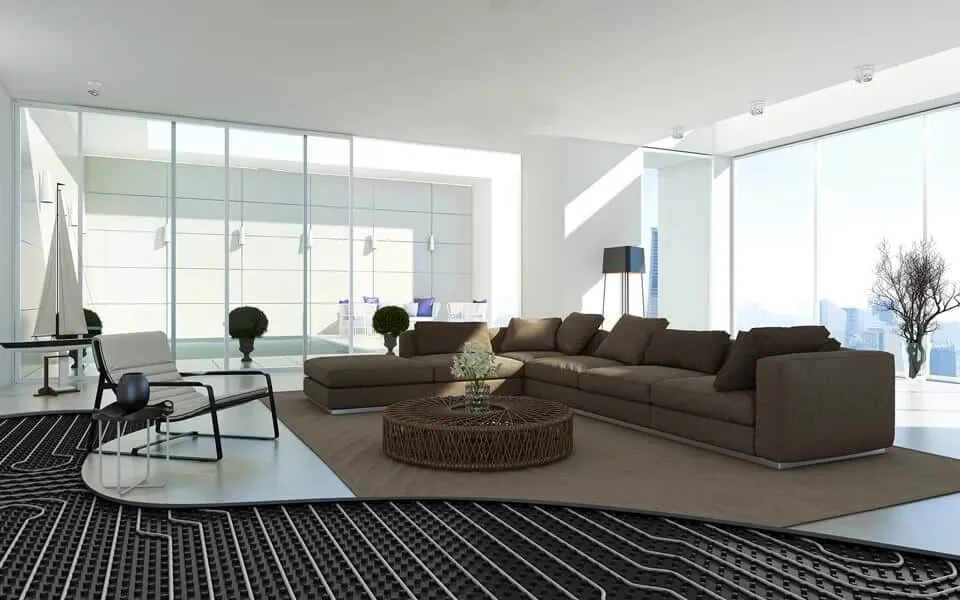
Reducing your home's carbon footprint starts with how you heat and cool. Here's how hydronics — paired with the right energy source — beats every alternative.
Heating and cooling typically account for 40% of a home's annual energy use. Choosing a low-carbon system is the single biggest decarbonisation lever most homeowners have.
The greenest hydronic system today is a heat pump driven by solar PV — operationally near zero-emissions, with a 30+ year design life.
Direct electric resistance: 0.7 kg CO2/kWh (AU grid avg). Gas boiler: 0.21 kg/kWh. Air-source heat pump (COP 4.0): 0.18 kg/kWh. Geothermal heat pump (COP 5.0): 0.14 kg/kWh. Solar-thermal + heat pump backup: <0.05 kg/kWh.
Pair any heat pump with rooftop solar PV and you can reach near-zero operational carbon.
Air-source or geothermal heat pump driven by solar PV — operationally near zero-emissions, with a 30+ year design life. Solar thermal heating is also excellent. Gas boilers are about 60% lower carbon than direct electric on the AU grid mix; heat pumps are about 75% lower than gas.
Yes — Small-scale Technology Certificates (STCs) apply to heat pumps and solar thermal under the Australian Renewable Energy Target. State-level rebates also apply (Victoria's VEU, NSW's Energy Savings Scheme). Typical savings $1,000–$3,000 off install. We handle the paperwork.
Yes — solar thermal collectors paired with a wood/pellet hydronic burner and a thermal store can provide year-round heating fully off-grid. We've done this for cabin and rural builds.
"AHHAC delivered our 22-zone underfloor system on time, on budget and to spec. The crew were tidy, the documentation was thorough, and the commissioning was textbook."
"We've worked with AHHAC for 17 years. They've installed and serviced our hot water plant across three commercial buildings — and they pick up the phone on weekends."
"Three mobs quoted us; AHHAC's design was the only one based on a proper heat-loss calculation. The system runs beautifully — the others would've been oversized and expensive."