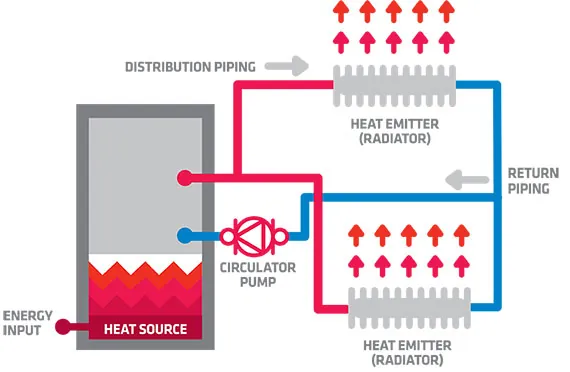
The short answer
UpdatedWhen hydronic heating stops working, check four things first: the thermostat or controller is calling for heat, the heat pump or boiler has power (and gas, if fitted), the pressure gauge sits in its normal cold range, typically about 1 to 1.5 bar on a sealed system, and the display shows no error code. Radiators cold at the top need bleeding; cold at the bottom means sludge. Gas faults, relief valves, repeat lockouts and falling pressure need a licensed technician.
Reviewed by the AHHAC Technical Team — licensed plumbers & hydronic engineers, NSW Lic 262528C.How we write & review
- Rule out the simple causes first: thermostat mode, power, gas supply, the pressure gauge and any error code.
- A sealed system typically reads about 1–1.5 bar cold, but your appliance manual and commissioning sheet are the authority.
- Cold at the top means air (bleed it). Cold at the bottom means sludge (flush and treat it).
- Pressure that keeps dropping, a dripping relief valve or repeat lockouts are licensed-technician jobs. Don't keep resetting or topping up.
- An annual service covering inhibitor, expansion vessel, filter, pump, controls and the heat source prevents most of these faults.
Hydronic heating not working? Start with these five checks
Before assuming the worst, rule out the simple causes. Plenty of "no heat" problems turn out to be a setting rather than a broken heat source.
- Thermostat or controller. Is it actually calling for heat? Check the schedule, holiday mode and set temperature and, on a reversible heat pump, that it hasn't been left in cooling mode since summer. Replace the batteries in wireless room thermostats.
- Power. Check the isolator switch beside the heat pump or boiler and the circuit breaker at the switchboard. A breaker that trips again straight after a reset is a job for a technician, not a second reset.
- Gas supply (boilers only). If the gas cooktop or gas hot water isn't working either, the problem is the supply, not the boiler.
- Pressure gauge. On a sealed system, read the gauge with the system cold. If it's near zero, most appliances will refuse to run.
- Display and error code. Write down the exact code and look it up in the user manual before touching anything else.
If all five check out, the cause is inside the system. The table below will help you narrow it down.
Common hydronic heating problems: symptom, cause and fix
Match what you're seeing to the most likely cause. The "safe check" column is what a homeowner can reasonably do. Anything in the last column needs a licensed technician.
| Symptom | Likely cause | Safe homeowner check | Call a technician if… |
|---|---|---|---|
| No heat anywhere | Controls, power, gas, low pressure or lockout | Thermostat mode, isolator, gauge, error code | The code returns after one reset |
| Pressure low or keeps dropping | Leak, recent bleeding, failed expansion vessel, relief valve discharging | Read the gauge cold; look for drips at valves and the relief valve outlet | Pressure falls again within weeks |
| Pressure too high or relief valve dripping | Overfilled, filling loop letting by, flat expansion vessel | Confirm the filling loop is closed; compare cold and hot readings | It nears 3 bar hot, or the relief valve discharges |
| Radiator cold at the top | Trapped air | Bleed the radiator, then re-check pressure | Air keeps coming back |
| Radiator cold at the bottom or patchy | Magnetite sludge | Note which radiators are affected | Always: it needs a flush and water treatment |
| One radiator cold all over | TRV pin stuck, valve closed, system out of balance | Open the TRV fully; bleed the radiator | Still cold after bleeding and opening the TRV |
| Banging or kettling | Scale or sludge in the heat exchanger, low flow or low pressure | Check pressure; note when it happens | The noise persists |
| Gurgling or whooshing | Air in the system, pump speed too high | Bleed radiators | Gurgling returns or the pump is loud |
| Underfloor zone not warming | Thermostat, manifold actuator, mixing valve or flow fault | Check the zone thermostat; allow time for slab systems | The zone stays cold after a full day of heating |
| Heat pump icing up or weak output | Defrost fault, blocked coil or condensate drain, flow settings | Clear leaves and debris by hand | Ice persists or output stays low |
Hydronic heating pressure too low, or keeps dropping
Most residential hydronic systems are sealed: the water is filled once, pressurised, and should hold that pressure for months. As a general guide, a sealed system typically reads around 1–1.5 bar (100–150 kPa) when cold and rises as the water heats and expands. That's a typical range only. The correct figure for your system is in the boiler or heat pump manual and on your installer's commissioning sheet, and taller homes are often set higher to suit the height of the pipework.
A low reading usually has one of four causes: radiators have recently been bled, there's a slow leak, the expansion vessel has lost its air charge, or the relief valve is discharging. Look for drips or white, crusty deposits at radiator valves, the manifold, the appliance connections and the relief valve discharge pipe.
If the manual allows owner top-ups, refill slowly through the filling loop to the stated cold pressure and close both valves fully. One top-up after bleeding is normal. Needing another within days or weeks is not. Fresh water brings in oxygen and dilutes the corrosion inhibitor, so a slow leak quietly speeds up sludge. That's the point to book a technician.
Hydronic heating pressure too high, or the relief valve is dripping
Pressure that climbs well above its normal hot reading points to one of three things: the system was overfilled, the filling loop is letting mains water through even when closed, or the expansion vessel has failed. A healthy vessel absorbs the extra volume of hot water. A flat or ruptured one can't, so pressure spikes every time the heating runs until the relief valve opens. Relief valves on most domestic hydronic appliances are set at around 3 bar.
The safe check is simple. Make sure both filling loop valves are closed, then compare the cold reading first thing in the morning with the reading after an hour of heating. Write both down, because it's exactly what a technician will ask for. Never tighten, cap or tamper with a dripping relief valve: it's a safety device doing its job. The fix is usually re-charging or replacing the vessel and resetting the system pressure, which is licensed work.
Hydronic radiator not heating? Cold at the top, the bottom or all over
Where a radiator is cold tells you a lot. Feel it carefully, because it can be hot enough to burn, once the system has been running for half an hour.
Cold at the top, warm at the bottom
Classic trapped air. Air rises to the top of the panel and stops hot water filling it. Bleeding the radiator, below, usually fixes it in minutes.
Warm at the top, cold at the bottom or in patches
This is sludge: magnetite, the black iron oxide that forms when steel components corrode inside the system. It settles in the bottom of radiators and in the heat exchanger, cutting output and straining the pump. Bleeding won't help. The fix is a central heating flush, a magnetic filter if one isn't fitted, and correct hydronic water treatment so it doesn't re-form.
Cold all over while the others are hot
Check the thermostatic radiator valve (TRV) is turned fully open. TRV pins can stick after a summer off; with the head unscrewed, the pin should spring back when pressed gently. If the lockshield valve at the other end has been closed, or the system has drifted out of balance, that radiator simply gets too little flow. Rebalancing is a technician's job.
How to bleed a hydronic radiator (step by step)
Bleeding releases trapped air through a small valve at the top corner of the radiator. You'll need a radiator key (some valves take a flat screwdriver), a cloth and a small container.
- Turn the heating off and let it cool. Hot water can scald, and a running pump can draw air in rather than push it out.
- Note the cold pressure on the gauge at the heat pump, boiler or filling point.
- Start at the lowest level of the house, at the radiator furthest from the heat source, then work up and back.
- Open the bleed valve slowly, a quarter to half turn anticlockwise, with the cloth held underneath. You'll hear air hiss out.
- Close it as soon as water runs steadily without spitting. Snug, not forced.
- Repeat on each radiator that was cold at the top.
- Re-check the pressure. If it's now below the manual's cold figure, top up through the filling loop as the manual describes, or call us.
- Turn the heating back on and check each radiator heats evenly from top to bottom.
Underfloor manifolds and most heat pumps use automatic air vents, so there's usually nothing to bleed there. If radiators need bleeding every few weeks, air is getting in or corrosion is producing gas inside the system. Both need a technician and a water test.
Noisy hydronic heating: banging, gurgling and whistling pipes
- Banging, knocking or a kettle-like rumble from the boiler or heat pump usually means water is overheating locally in a restricted heat exchanger, caused by scale, sludge, low flow or low pressure. Check the pressure, then book a service. Ignoring it shortens the life of the heat source.
- Gurgling or trickling in radiators or pipes is air. Bleed the radiators, and if it comes back, find out why.
- Whooshing or whistling often means water is moving too fast: the pump speed is set too high, or most TRVs have closed and there's no bypass. A variable-speed circulating pump set to the right curve is normally near-silent.
- Ticking or creaking as the system warms up and cools down is pipe expansion rubbing against clips or timber. It's usually harmless and can be cured with better pipe supports.
- A hum or vibration at the pump can be a worn bearing or poor mounting. Have it checked at the next service.
Boiler lockout and error codes: what you can safely reset
A lockout is the boiler or heat pump protecting itself. Gas boilers commonly lock out on ignition or flame failure, low system pressure, a blocked condensate pipe (common in a cold snap, when an external condensate line can freeze) or a flue fault. Heat pumps typically show codes for low water flow, sensor faults, or high or low refrigerant pressure.
The safe sequence is: write down the exact code, look it up in the user manual, check the system pressure, and confirm power and gas supply. Most manufacturers allow the owner to press reset once. If it locks out again, stop. Repeated resets on a gas appliance can mask a combustion or flue fault. Opening the casing, adjusting the gas valve or bypassing safety devices is licensed gasfitting work, and any refrigerant work on a heat pump needs a licensed refrigeration technician.
If you smell gas: don't operate switches or use naked flames, turn the gas off at the meter if it's safe to do so, ventilate, leave the house and call your gas distributor's emergency line (it's printed on your gas bill), or 000 if anyone is in danger.
Underfloor zone or heat pump not heating properly
Underfloor heating is slow by design. An in-slab system can take 2–8 hours to respond, so a cool room on the first cold morning isn't necessarily a fault. If one zone stays cold after a full day, check its room thermostat first, then look at the manifold. Each loop has a thermal actuator on top (many show an indicator when open) and a flow meter. A failed actuator or a stuck mixing valve is a straightforward repair for a technician.
Air-source heat pumps periodically defrost their outdoor coil in cold, damp weather. You may see steam or water, and the heating may pause for a few minutes. That's normal. Ice that keeps building, a coil packed with leaves, or a blocked or frozen condensate drain is not. Keep the clearances shown in the manual, clear debris gently by hand, and never chip at ice or hose the fins hard. Weak output is often a settings issue, such as a flow temperature or weather-compensation curve set too low for the emitters.
Some rooms warm, others cold: balancing and sizing problems
When the system runs but heat is uneven, with rooms nearest the plant too warm and the far bedroom never quite getting there, the usual cause is balance. Water takes the easiest path, so short circuits get too much flow and long ones too little. Balancing sets each radiator's lockshield, or each underfloor loop's flow meter, so every room gets its share. Good balancing valves and TRVs make that setting stick.
The other cause is sizing. A home converted from a gas boiler to a heat pump without upsizing the radiators runs cooler water through the same panels, and some rooms will fall short on cold days. Controls matter too: a badly placed thermostat or a weather-compensation curve that isn't tuned to the house will undercook some rooms. Our hydronic thermostats and controls page explains how zoning should work.
What should an annual hydronic heating service include?
Most of the problems above are cheaper to prevent than to fix. A proper annual service should cover:
- Water test and inhibitor: inhibitor concentration and water condition checked, then re-dosed to the system volume.
- Pressure and expansion vessel: cold and hot readings, plus the vessel's air pre-charge checked and reset.
- Relief valve: operation and discharge line checked.
- Filter and dirt separator: magnetic filter cleaned and strainers cleared.
- Circulating pump: flow, noise and speed setting.
- Controls: thermostats, schedules, sensors and the weather-compensation curve.
- Gas boiler: combustion analysis, burner, flue and condensate trap, by a licensed gasfitter.
- Heat pump: outdoor coil and fan cleaned, condensate drain, defrost operation, flow rate and electrical connections.
- Emitters: radiators bled, TRVs exercised, underfloor actuators and flow meters checked, balance confirmed.
Beyond that, we typically recommend a power flush every 5–7 years for residential systems, or sooner if sludge symptoms appear. For gas appliances specifically, Energy Safe Victoria advises servicing by a licensed gasfitter at least every two years, because carbon monoxide can't be seen or smelled.
When to stop troubleshooting and call a licensed technician
Homeowner checks often solve the problem and always make a service call faster. But some jobs are licensed work, and some faults get more expensive the longer they run. Call a technician when:
- pressure keeps dropping, or the relief valve discharges
- a lockout returns after one reset, or there's any sign of a gas or flue problem
- radiators are cold at the bottom, or the water you bleed comes out black
- banging from the heat source continues
- a heat pump keeps icing up or shows refrigerant-related codes
- rooms stay cold after bleeding and opening the TRVs
AHHAC's in-house licensed plumbers and hydronic engineers service and repair hydronic systems across NSW, the ACT, Victoria and Queensland, including systems installed by others. Find local detail on our hydronic heating Sydney, hydronic heating Melbourne and Canberra pages, or book a hydronic heating service and send us the error code, your cold and hot pressure readings and a photo of the appliance label.
Sources & how this guide was written
- Manufacturer installation and servicing manuals for hydronic boilers, heat pumps, expansion vessels and pumps, the authority on pressures, resets and error codes for any appliance.
- AS/NZS 3500 (plumbing and drainage) and AS/NZS 5601 (gas installations), the standards AHHAC installs and services to.
- Energy Safe Victoria's home heating safety guidance on gas appliance servicing and carbon monoxide (linked above).
- Water treatment manufacturer guidance on inhibitor dosing and flushing.
- AHHAC's own design, commissioning and service experience across 2,400+ hydronic systems installed.
This guide was written and reviewed by the AHHAC Technical Team, licensed plumbers and hydronic engineers (NSW Lic 262528C). It will next be reviewed before winter 2027.